
Who would have thought a ransom note would come with a sales pitch?
I’ve read one. A company came to us after cybercriminals had already locked them out of their systems. In the middle of that chaos, I read the note the attackers left behind.
It opened with “Hello!” Then it got down to business: “We work for money and are not associated with politics.”
Next came a six-step “communication process.” Contact us. We’ll show you what we stole. We’ll unlock one file to prove our tool works. Pay in Bitcoin. We’ll delete our copies of your data and hand over the tool to unlock your systems. And step six… “a detailed report on how we compromised your company, and recommendations on how to avoid such situations in the future.”
The payment portal was called the “client area.” They signed it “Sincerely.”
How thoughtful of them!
Now picture that same note on the front desk computer of a medical practice. Patients are checking in. The schedule is frozen. Nobody can open a chart. And somewhere around 2 a.m., the practice administrator types one question into Google…
Key takeaways
- When ransomware encrypts patient information, HHS presumes a HIPAA breach unless your practice can document a low probability the data was compromised.
- Paying the ransom doesn’t undo the breach. It also doesn’t guarantee your stolen data ever gets deleted.
- OCR’s 2026 ransomware settlements keep pointing to the same gap: a missing or outdated HIPAA risk analysis.
- Your IT provider needs a signed BAA. Free and self-serve AI tools like ChatGPT aren’t covered by one.
Is a Ransomware Attack a HIPAA Breach?
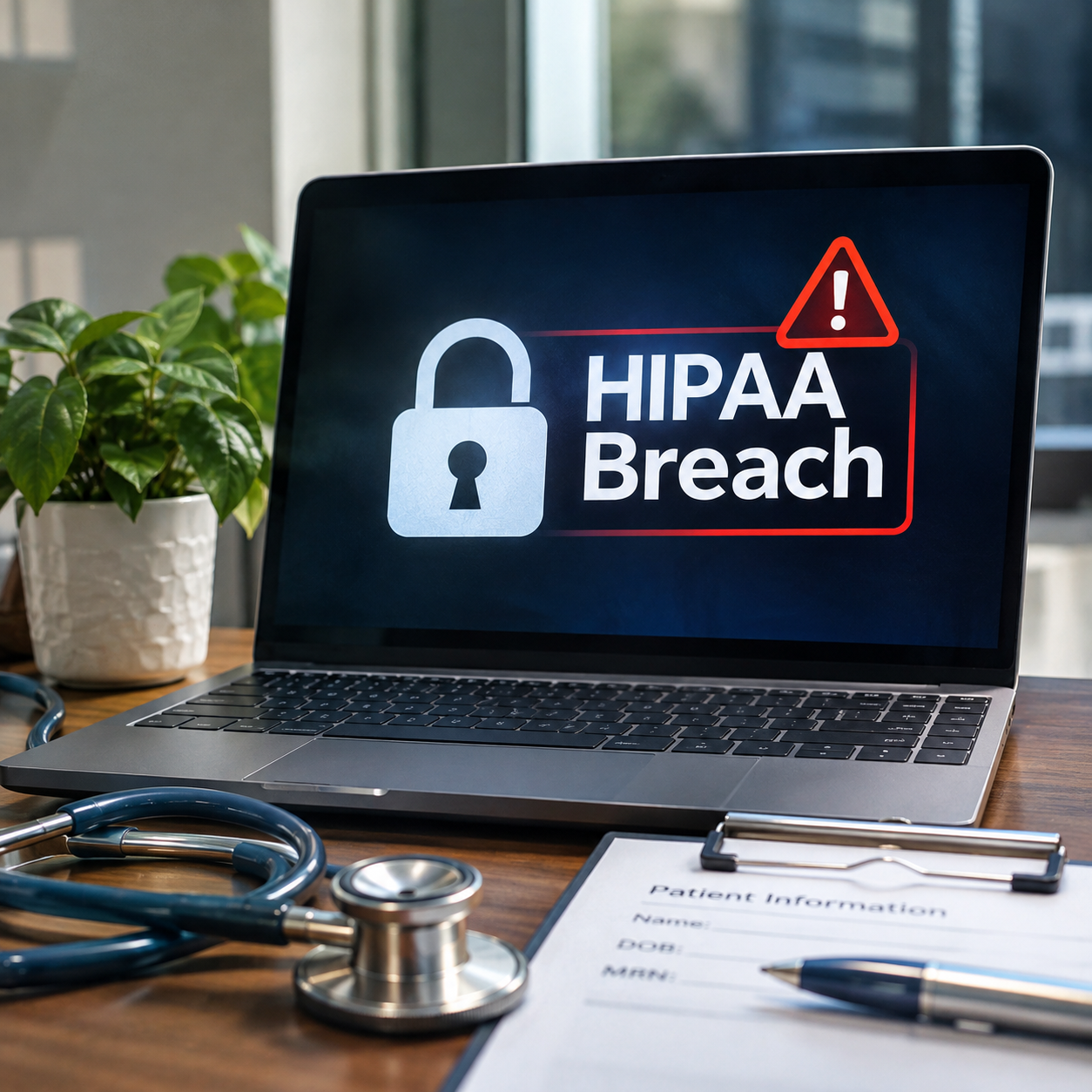
Usually, yes. According to HHS’s ransomware guidance, when ransomware encrypts patient information, a HIPAA breach is presumed. Your practice can only overcome that presumption by documenting, through a risk assessment, that there’s a “low probability” patient information was compromised. If you can’t prove it, you notify.
Read that again. The burden of proof sits with your practice.
Paying the ransom doesn’t change it either. The patient data was still in cybercriminals’ hands, even if they hand it back with a smile and a “Sincerely.”
Why Do Ransomware Gangs Target Medical Practices?
That note wasn’t a fluke. Ransomware runs like a business now. One group builds the tools. “Affiliates” rent them, carry out the attacks and split the profit. According to Check Point Research, one of 2026’s most active ransomware groups recruits affiliates with a 90% cut of every ransom.
Healthcare is one of their best customers. Hacking and IT incidents caused more than 80% of the large healthcare data breaches reported to HHS in 2025. Patient records are valuable, practices can’t stop seeing patients for long and that pressure gets ransoms paid.
Cybercriminals have a business plan for getting into your practice. Do you have one for keeping them out?
How Nice of Them to Offer a Report
These aren’t honest people. Paying doesn’t guarantee you a report, a working decryption key or that your stolen data ever gets deleted.
One company that came to us had backups and still never got their data back. Another paid the ransom and still lost 20 years of data! Researchers recently found stolen data from 12 U.S. organizations still sitting on one gang’s server, long after the attacks were over.
For a medical practice, “still sitting on a server” means names, birthdays, insurance numbers and diagnoses. That data gets sold again and again.
What Does HHS Look for After a Ransomware Attack?
The ransom is only the first bill. The second one can come from the HHS Office for Civil Rights (OCR), the agency that enforces HIPAA.
In April 2026, OCR settled four ransomware investigations in a single day, totaling $1,165,000. One was a women’s health provider where the attack reached the records of nearly 38,000 patients. OCR’s main finding? The provider had never done an accurate and thorough HIPAA risk analysis. That cost $320,000.
That’s the pattern. OCR runs a Risk Analysis Initiative because the missing or outdated risk analysis shows up in breach after breach. It’s one of the first documents investigators ask for… and the one too many practices haven’t touched since the day they opened.
Does HIPAA Require Multi-Factor Authentication?
Today, HIPAA doesn’t name MFA, but it does require you to verify who’s logging in and to protect patient data based on your risk analysis. MFA is the safeguard regulators and insurers expect to see.
HHS has also proposed the biggest update to the HIPAA Security Rule in years. The proposal would make MFA and encryption mandatory, require annual penetration testing and vulnerability scans every six months and require a written plan to restore systems within 72 hours. As of now it’s still a proposal, with final action targeted for July 2027.
Don’t wait for the deadline. Cyber insurance carriers already aren’t. I spent 24 years in insurance and still talk with cyber carriers all the time. Today, you can’t even get a standalone cyber liability policy without MFA, tested backups and a risk analysis.
What Would a Ransomware Gang’s Report Say About Your Practice?
The same open doors show up again and again.
- Logins: A shared front desk password. No MFA on email or the EHR. A fake “IT support” call that talks someone into a password reset.
- Remote access: Unpatched VPNs and firewalls, plus the remote tools vendors use to get in.
- Vendors: Billing companies, EHR vendors and your IT provider all touch patient data.
- AI tools: A staff member pastes patient details into a free chatbot to write an insurance appeal. OpenAI won’t sign a Business Associate Agreement for the free, Plus or Business (formerly Team) versions of ChatGPT, so that patient information just left your practice.
- Accounts nobody remembers: Former employees, old vendor logins and admin access that never got turned off.
Does My IT Company Need to Sign a BAA?
Yes, if they can access systems that hold patient information. Under HIPAA, anyone who creates, receives, maintains or transmits protected health information on your behalf is a business associate. That includes your managed IT provider, even if they never open a chart. You need a signed Business Associate Agreement (BAA) before they do the work.
A signed BAA is the starting line. Ask your IT provider to show you MFA on every account, backups that have actually been tested, who is watching your network at night and when your last risk analysis was done. Verify, then trust.
At IT ArchiTeks, we sign a BAA with every healthcare client. We also require signed BAAs from every vendor and tool in our own stack that touches client data, down to the cloud platforms we use. Your patients’ data is only as safe as the weakest vendor behind your IT provider.
Outsourcing your technology does not mean outsourcing your risk.
Pay Now or Pay Later
I’d much rather be on the other side of that conversation… the one where a practice leader calls us before the ransom note shows up. Too often it takes that much pain before someone picks up the phone.
You’re going to pay for that report one way or another. Pay for an independent risk assessment now, while someone’s on your side and you can plan it into your budget. Or pay cybercriminals for their report later, on their terms… then pay for breach notification, then answer to OCR.
In my Proof to Profit keynote, I call this Prove. Believing you’re protected and proving it are two very different things. You wouldn’t read your own biopsy or sign off on your own chart without a second set of eyes.
Even your doctor has a doctor.
What Can Your Practice Do This Week?
- Find your HIPAA risk analysis. If it’s more than a year old, or nobody can find it, that’s your answer.
- Turn on MFA for email, the EHR, VPN and every remote login.
- Ask every vendor that touches patient data for a signed BAA, starting with your IT provider.
- Set one AI rule today: no patient information goes into any AI tool the practice hasn’t approved. And verify any call from “IT” through a number you already have on file.
How IT ArchiTeks Helps Medical Practices Meet HIPAA Security Requirements
HIPAA compliance is your practice’s program. Our job is to work with you so the technical safeguards the Security Rule expects are in place, monitored and documented. Here’s how our HIPAA managed IT services line up:
- Business Associate Agreements, all the way down: We sign a BAA with you and hold every vendor and tool in our stack that touches your data to the same standard.
- Cyber Risk Assessment and penetration testing: An independent look at your people, systems, data and AI use. Supports the HIPAA risk analysis and risk management requirements, plus the annual penetration testing the proposed rule would require.
- 24/7 U.S.-based SOC and SIEM monitoring: Our Security Operations Center has analysts watching around the clock. Supports HIPAA’s audit controls and information system activity review.
- Cyber Threat Hunting and AI-enabled endpoint protection: We look for attackers already inside and stop malware on every device. Supports protection from malicious software.
- MFA and secure remote access: Supports person or entity authentication and access controls.
- Patch management: Keeps the firewalls, VPNs and systems cybercriminals target most up to date.
- Security awareness training: Teaches your front desk and clinical staff to spot the fake IT call and verify before they click. Supports HIPAA’s security awareness and training standard.
- Dark Web Monitoring: Alerts you when your practice’s logins show up for sale.
- AI Readiness and Risk Assessment: Finds the AI tools your staff is already using and builds the guardrails around patient data.
- Backup and disaster recovery: Encrypted backups we actually test, so when cybercriminals lock your systems you can restore your patient data instead of negotiating for it. Supports HIPAA’s data backup, disaster recovery and contingency plan requirements, plus the 72-hour restoration standard the proposed rule would add.
- Incident response and recovery: When the worst happens, our cybersecurity team has been there. Supports your security incident procedures.
Want to talk through what this looks like for your practice? Book a short strategy session with our team.
Join Us for Breakfast in Dallas
Every month, IT ArchiTeks opens our Dallas office to medical practice leaders for breakfast and a straight talk about the risks facing practices right now: cybersecurity and HIPAA, using AI safely and marketing that brings in patients and protects your profits. Protecting patient data protects patient care. It also protects your revenue.
Protect Your Practice and Profits Breakfast
Friday, December 4, 2026, 7 to 9 a.m.
IT ArchiTeks, 17101 Preston Rd, Suite 100, Dallas, TX 75248
Save your seat
Frequently Asked Questions
Do I have to report a ransomware attack to HHS?
If it’s a breach, yes. Under the Breach Notification Rule, patients must be notified without unreasonable delay and no later than 60 days after discovery. Breaches affecting 500 or more people must also be reported to HHS within 60 days. If more than 500 residents of one state are affected, local media must be notified too. Smaller breaches are reported to HHS within 60 days after the end of the calendar year.
Can my staff use ChatGPT with patient information?
Not the free, Plus or Business (formerly Team) versions. OpenAI won’t sign a Business Associate Agreement for them, so entering patient information is likely an impermissible disclosure. Use only AI tools your practice has approved and covered with a BAA.
How often should a medical practice do a HIPAA risk assessment?
HIPAA requires an accurate and thorough risk analysis that you keep current, especially when systems change. Annually is the common standard. The proposed Security Rule would require at least a yearly review.
Not Sure Where Your Open Doors Are?
Think you’re ready? Prove it in 5 minutes.
Take the 5 Minute Prove It Quiz. It’s 10 questions and shows where your practice’s open doors are right now.
Take the 5 Minute Prove It Quiz
Dedicated to your security,
Melanie Padron
Legacy Defender, Cybersecurity Truth Teller
Written by Melanie Padron
Vice President of Strategic Growth · IT ArchiTeks
Risk Strategist · National Cybersecurity Speaker
Melanie Padron brings nearly three decades of risk management experience, spanning insurance and cybersecurity, to help trucking and logistics leaders validate security posture, strengthen resilience, and protect revenue before pressure reveals what preparation concealed.
She’s a nationally recognized cybersecurity keynote speaker and the creator of two acclaimed talks:
- Surviving a Cyber Crisis: Real Stories. Real Lessons. Real Money.
- Proof to Profit: How Leaders Protect Revenue in the Age of Ransomware and AI
To bring either conversation to your conference, association, or leadership team, visit ITArchiTeks.com or connect with Melanie directly on LinkedIn.
About IT ArchiTeks
IT ArchiTeks is a veteran-owned, SDVOSB-certified managed IT and cybersecurity provider that has served Dallas-Fort Worth for more than 20 years, with an office in The Woodlands serving the Houston area. We work with medical practices on HIPAA-focused cybersecurity, AI readiness and incident response, backed by 24/7 U.S.-based security monitoring and direct access to a CIO, CTO or CISO. Learn more at ITArchiTeks.com.


