

After one of my Proof to Profit keynotes, a senior executive from a major steel manufacturer walked up to me, shook my hand and said, “You did a great job. You have me scared.”
He’d never stopped to think that a criminal could be sitting inside his systems right now… watching, mapping, reading bank statements and studying his cyber liability policy limits. Learning exactly how the operation ran so they’d know what it would cost to bring it to its knees.
This week that fear got a lot more real for anyone in transportation. Especially here in Texas.
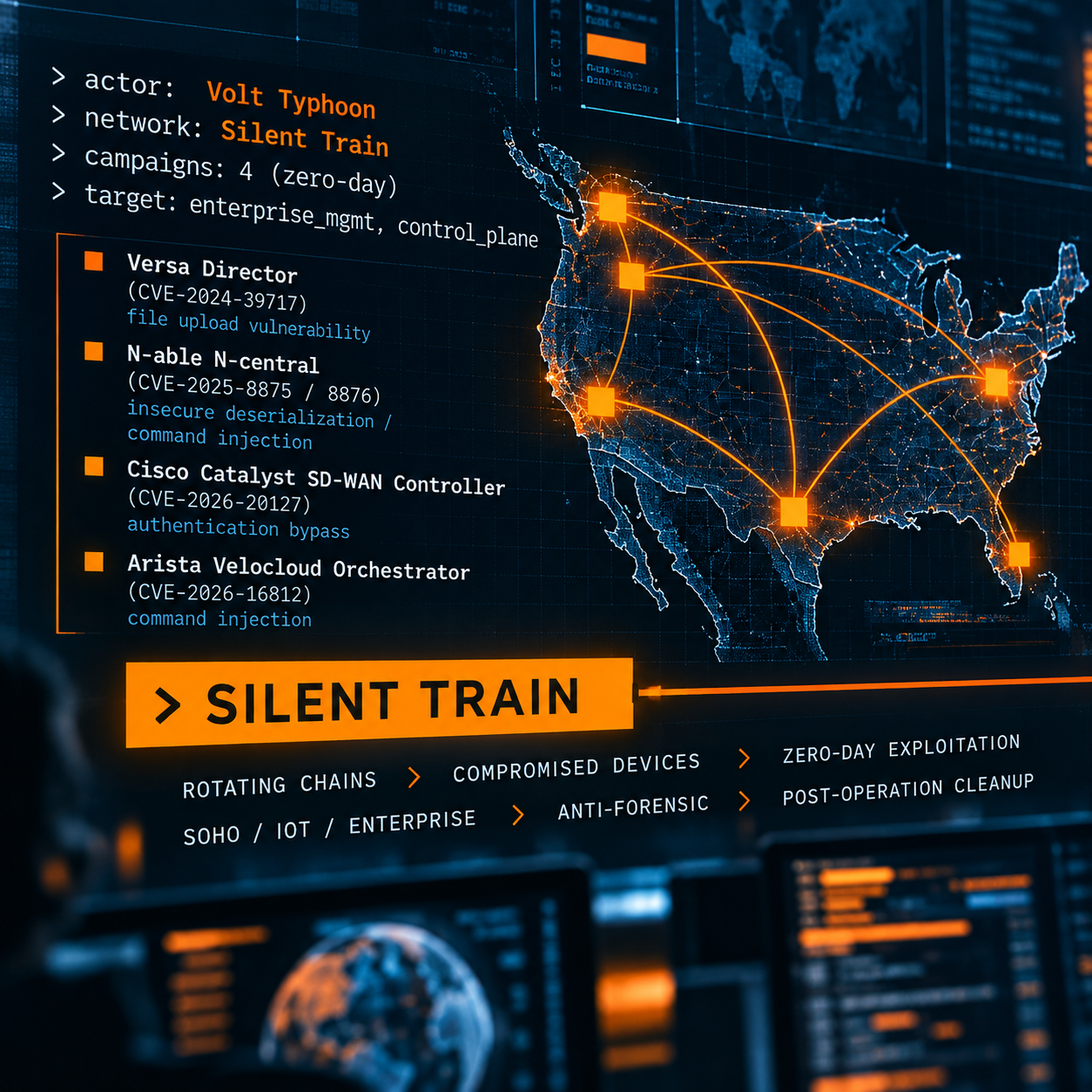
On October 28, researchers at Lumen’s Black Lotus Labs published new findings on Volt Typhoon, the China-linked hacking group I wrote about in my last blog, There’s Already Someone Inside. The targets include transportation, rail, maritime, and aviation. And Texas, along with California and Hawaii, is one of the three most targeted U.S. states.
Melanie Padron explains what Volt Typhoon’s Silent Train means for Texas transportation companies.
Key takeaways
- On October 28, 2026, Lumen’s Black Lotus Labs reported that Volt Typhoon, a China state-sponsored hacking group, built a covert network called Silent Train from hijacked routers and business devices.
- Texas, California, and Hawaii were the most targeted U.S. states. Targeted sectors include transportation, rail, maritime, and aviation.
- Smaller fleets may not be the target, but they can be the doorway through outdated routers, default passwords, and vendor remote access.
- Start this week: replace unsupported devices, update firmware, change default passwords, require MFA everywhere, and ask your IT provider the six questions below.
What Is Volt Typhoon and What Did Researchers Just Find?
Volt Typhoon is a state-sponsored hacking group tied to China. In February 2024, CISA, the NSA and the FBI warned that it was quietly pre-positioning inside U.S. critical infrastructure like transportation. In some networks it stayed hidden for at least five years. Five years!
The new research shows how they’ve been pulling it off. Volt Typhoon built a covert network the researchers call Silent Train out of hijacked everyday equipment: small office and home routers, internet-connected devices, and business gear from brands like TP-Link, Netgear, Zyxel, Fortinet, and Cisco. At least 27 types of devices. Hundreds of victims.
They used that network to break into the tools companies rely on to manage their own IT… the software that controls networks, devices, and remote access across an entire business. Black Lotus Labs says Silent Train has since been disrupted. But this group rebuilds. The researchers describe chains of hijacked devices used once, then thrown away and rebuilt whenever they need a new one.
Why Is Texas a Target?
Texas has what a nation-state wants access to in a crisis. The researchers point to states that host military bases, telecom infrastructure, defense contractors, satellite providers, and critical logistics networks. Texas checks every box.
Think about what moves through this state every day. Ports, rail yards, border crossings, distribution centers, and thousands of trucks tying it all together. Black Lotus Labs links the activity to keeping access open as tensions rise in the Indo-Pacific. If you wanted to slow a country down without firing a shot, you’d start with how it moves goods.
Is My Trucking or Logistics Company Really a Target?
You may not be the target, but your company can be the doorway into someone who is. I hear this one all the time. “We’re a small fleet. Why would China care about us?”
Here’s the hard part.
Volt Typhoon’s whole model runs on borrowing other people’s equipment. A router nobody has updated since the day it was installed… a device sitting on the network with its default password… a remote connection into a bigger customer or partner. Each one gets them a step closer to something bigger.
And our industry makes it easy. Trucking and transportation are known for running old, legacy systems. I’ve helped clients recover from ransomware whose systems were so tangled together, old software bolted onto older software, that restoring them was extremely difficult. Every one of those old systems is a door that might be open just a crack.
That’s what worries me most right now. Cybercriminals are using AI to string small, low-risk vulnerabilities together, daisy chaining them into one big attack.
A door that’s only cracked open still lets them in.
Could Hackers Be Inside My Network Right Now Without Me Knowing?
Yes. Attackers can stay hidden inside a company’s network for months or even years by using the company’s own tools. And it’s the part I talk about most from the stage.
Several of the clients we’ve helped recover had forensic investigations trace the first breach back more than 12 months. Over a year! Criminals were living off the land, using the company’s own tools so nothing looked out of place, gathering intel until it was valuable enough to sell. Then a second criminal gang that specializes in ransomware bought that access and dropped the payload.
That’s how organized this has become. The criminal business model is commoditized. Gangs specialize and partner up, handing work off to each other like any other supply chain.
Volt Typhoon works the same way, just with a government behind it. The researchers found its sessions often lasted just hours, some only minutes, with everything cleaned up afterward. It’s built to leave no trace.
So when someone tells me, “We haven’t seen anything,” my answer is always the same. That doesn’t prove nothing happened. It might just prove they’re good.
Can My Office Router Really Be Used to Attack Someone Else?
Yes. A hijacked office or home router can be used to attack someone else. And it’s one of the easiest risks to fix.
Silent Train was built from the kind of equipment sitting in offices, home offices, and truck cabs all over Texas. A hijacked router doesn’t have to steal anything from you. It just relays traffic so the attack looks like it’s coming from a normal U.S. business. Yours.
Do this now: Replace any equipment the manufacturer no longer supports. Update the firmware on everything else. Change default passwords and turn off remote management on any device that doesn’t need it.
Should I Be Worried About My IT Provider’s Tools?
You should ask about them. Researchers found Volt Typhoon breaking into the management tools IT providers use to run many companies’ systems at once. This question matters for every company that works with an MSP. I say that as someone who works for one.
Targets included internal IT teams’ tools and a remote management product built for MSPs. From a criminal’s point of view, that’s smart. One door can open many.
Outsourcing your technology doesn’t mean outsourcing your risk.
A good provider will welcome these questions:
- Is MFA turned on for every account that can reach our systems, including yours?
- How fast do you patch critical and zero-day vulnerabilities?
- Is our network separated from your other clients?
- Who watches the alerts? What happens at 2 a.m. on a Sunday?
- If we’re attacked, how long until a forensics team is working on it?
- When was our environment last independently assessed?
Fuzzy answers are your cue to sit down for a deeper conversation.
How IT ArchiTeks Closes These Gaps
Every open door in this story has a fix. Here’s how we match the service to the threat.
- Intruders hiding for months: Our 24/7 U.S.-based Security Operations Center watches your environment around the clock with SIEM monitoring, pulling alerts from across your network into one place where a person owns every one of them. Cyber threat hunting goes a step further, looking for the quiet signs of someone living off the land before any alarm goes off.
- Old routers and legacy systems: Through our managed IT services we keep an inventory of everything on your network, patch by severity with critical and zero-day fixes first, and replace equipment the manufacturer no longer supports. AI-enabled endpoint protection watches every laptop and server for behavior that doesn’t belong.
- Small vulnerabilities chained together: Penetration testing does what cybercriminals do. It strings small weaknesses together to show you which ones add up to a way in.
- Vendor and partner access: We help you put MFA on every account, least privilege access, and zero trust in place. Verify, then trust. Vendor accounts get only what they need and close when the work is done.
- AI tools nobody approved: Our AI Security and Governance service finds the AI tools your team is already using, keeps sensitive data out of the wrong ones, and puts a short, simple policy in place.
- The worst day: Tested backup and disaster recovery, plus a written incident response plan your team has actually practiced, so an attack doesn’t end your business.
Timing is everything in a cyberattack. The difference between 18 hours of downtime and 18 months of recovery often comes down to how fast someone acts. One fuel hauler we work with was hit by ransomware and was back up and running in 18 hours. Zero ransom paid!
And it all starts in the same place. An independent cyber risk assessment finds your open doors before criminals do. You can’t grade your own homework. Once you know where the doors are, you can start closing them one at a time.
Close the Doors One at a Time
You can’t close every door overnight. But you can start this week.
Cybercriminals have a business plan for getting into your company. Do you have one for keeping them out?
Not sure where your open doors are? Take the 5 Minute Prove It Quiz and see your score as soon as you finish. Want to talk through what it means for your company? A short strategy session is the easy next step. And if you’d like these lessons presented to your team, your association, or your conference, I’d welcome that conversation too.
Take the 5 Minute Prove It Quiz | Book a Strategy Session
Written by Melanie Padron
Vice President of Strategic Growth · IT ArchiTeks
Risk Strategist · National Cybersecurity Speaker
Melanie Padron brings nearly three decades of risk management experience, spanning insurance and cybersecurity, to help trucking and logistics leaders validate security posture, strengthen resilience, and protect revenue before pressure reveals what preparation concealed.
She’s a nationally recognized cybersecurity keynote speaker and the creator of two acclaimed talks:
- Surviving a Cyber Crisis: Real Stories. Real Lessons. Real Money.
- Proof to Profit: How Leaders Protect Revenue in the Age of Ransomware and AI
To bring either conversation to your conference, association, or leadership team, visit ITArchiTeks.com or connect with Melanie directly on LinkedIn.
About IT ArchiTeks
IT ArchiTeks is a veteran-owned, SDVOSB-certified provider of IT, cybersecurity, and AI services that has supported businesses across Dallas-Fort Worth for more than 20 years and now has an office in The Woodlands serving the Houston area. With 24/7 U.S.-based security monitoring and direct access to a CIO, CTO, or CISO, we work with transportation, logistics, and other Texas companies to find their security gaps and close them before criminals find them.


